
Cannabis is not a modern phenomenon—it has been intricately woven into human civilization for thousands of years. From its earliest recorded uses in ancient China and India to its presence in the Middle East, Europe, and the Americas, cannabis has served multiple purposes: as a medicinal remedy, a tool for spiritual and religious rituals, a creative stimulant, and even as a recreational substance. Historical records reveal that cannabis was highly valued not only for its psychoactive effects but also for its practical applications, such as in textiles, rope, and ointments.
Throughout history, cannabis has captured the imagination and curiosity of countless people, including some of the most influential figures in science, literature, art, and politics. These historical personalities often used cannabis in ways that went beyond simple recreation. For many, it became a source of inspiration, a means to explore altered states of consciousness, a way to alleviate physical or emotional ailments, or a spiritual aid to deepen meditation and reflection.
Examining these figures and their relationship with cannabis provides a fascinating window into the cultural and social attitudes toward the plant across different eras. While modern perspectives on cannabis are often polarized—ranging from medical acceptance to legal prohibition—historical accounts show a more nuanced story. In the past, cannabis was frequently embraced for its perceived benefits, both practical and profound.
From legendary writers and poets who may have drawn creative energy from cannabis, to pioneering scientists who experimented with it to stimulate new ways of thinking, to spiritual leaders and musicians who used it as a tool for reflection and expression, the influence of cannabis spans diverse fields and centuries. These stories challenge modern preconceptions, showing that cannabis has long been intertwined with human innovation, creativity, and personal exploration.
In this blog, we will explore some of these well-known historical personalities, delving into how they used cannabis, the cultural context of their time, and the ways in which the plant may have shaped their work, thoughts, and achievements. By understanding the historical significance of cannabis and its connection to some of the world’s most prominent figures, we gain insight not only into the past but also into the evolving relationship between humans and this remarkable plant.
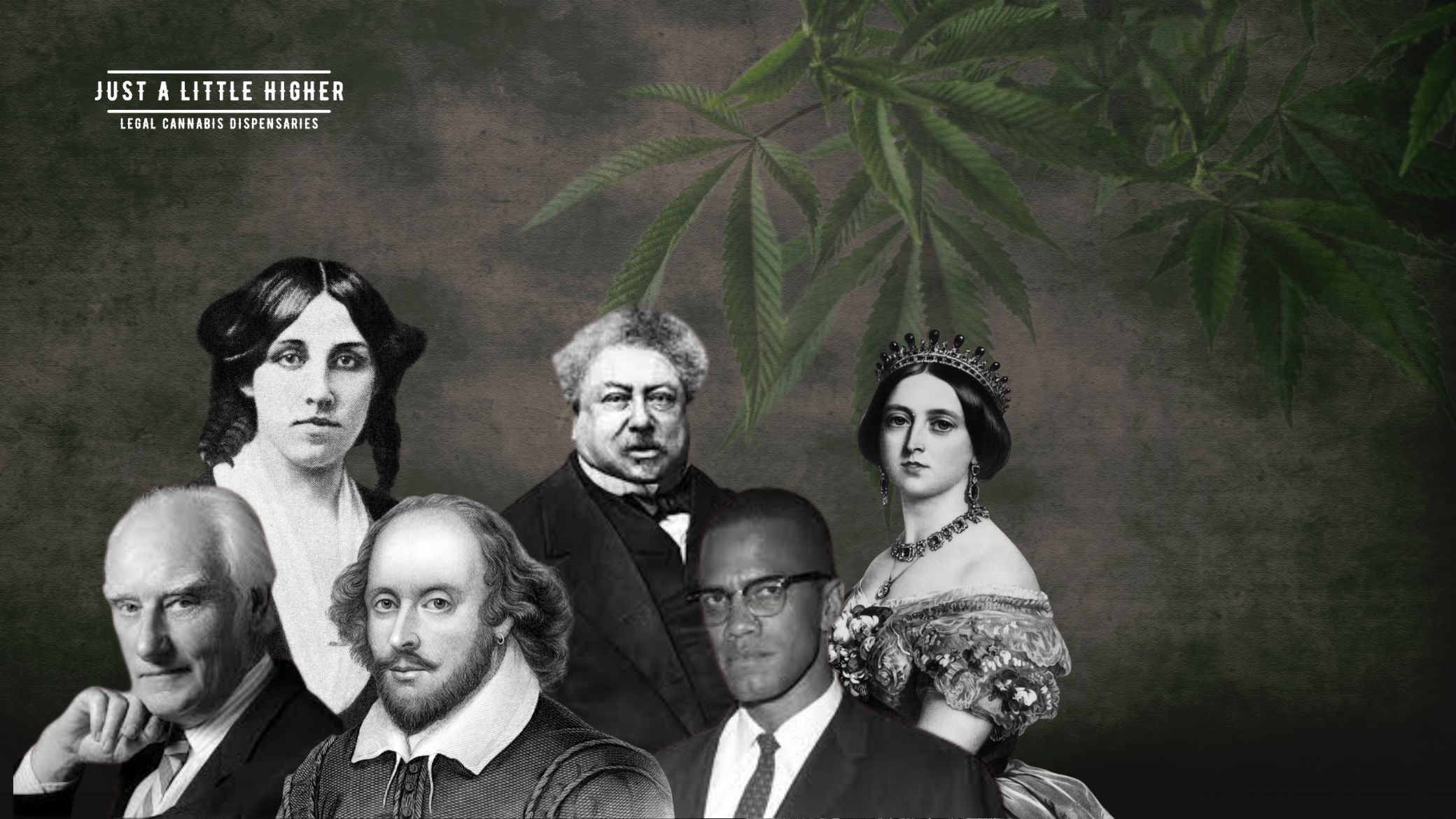
1.Alexandre Dumas
The French novelist Alexandre Dumas, author of The Three Musketeers and The Count of Monte Cristo, is said to have experimented with cannabis in social and creative contexts. In 19th-century France, hashish was popular among writers, poets, and artists who frequented literary salons. These gatherings often involved discussions of literature, philosophy, and art, with cannabis serving as a creative stimulant.
For Dumas, cannabis may have aided his prolific output and imaginative storytelling. It could have facilitated moments of mental clarity and inspiration, helping him craft complex plots, memorable characters, and immersive worlds. His use illustrates how European literary culture often embraced substances like cannabis as tools for unlocking creativity and enhancing the intellectual environment of artists and writers.

2. William Shakespeare
William Shakespeare lived in Elizabethan England, a time when hemp and cannabis products were common. Evidence suggests that hemp seeds, oils, and other cannabis based products were used in daily life, both for industrial purposes and personal consumption. While there’s no direct evidence that Shakespeare smoked cannabis, it is plausible that he may have experimented with it or been influenced by its presence in his social and cultural environment.
Cannabis is thought to have influenced creative thinking in many writers, and Shakespeare’s work is no exception. The vivid imagery, surreal metaphors, and imaginative storytelling in his plays and sonnets might have been subtly enhanced by substances like cannabis, which were known to relax the mind and encourage unconventional thought. Cannabis may have helped stimulate lateral thinking, a quality essential for the literary innovation Shakespeare achieved.

3. Queen Victoria
Queen Victoria, one of the most iconic monarchs in British history, reportedly used
cannabis tinctures prescribed by her physician, Sir J. Russell Reynolds. During the 19th
century, cannabis was widely recognized in medical circles for its ability to relieve pain and
reduce menstrual cramps. Queen Victoria’s documented use is significant, as it
demonstrates that even royalty turned to natural remedies for relief before the advent of
modern pharmaceuticals.
Cannabis in Victorian England was a standard part of medical practice, often consumed as
a tincture or infusion. For Queen Victoria, it wasn’t about recreation but about managing
chronic pain in a discreet and socially acceptable manner. Her use also highlights the
broader historical perception of cannabis as a therapeutic tool rather than a recreational
vice. Some historians suggest that her physician’s recommendation helped lend credibility
to cannabis in medical circles, influencing its perception among upper-class society.

4. Louisa May Alcott
Louisa May Alcott, famed for Little Women, reportedly used cannabis medicinally. In 19th century America, cannabis was commonly included in tonics and remedies for ailments ranging from insomnia to anxiety and chronic pain. Alcott, who often struggled with her health while maintaining a prolific writing schedule, may have relied on cannabis to manage her symptoms and maintain her productivity.
For Alcott, cannabis was likely a quiet companion in her life of discipline and creativity. Its calming and pain-relieving properties may have enabled her to focus on her literary endeavors, producing novels that explored family, morality, and social issues. Her use reflects a period when women, in particular, sought natural remedies for conditions that modern medicine was not yet equipped to treat, demonstrating how cannabis functioned as a supportive tool in their personal and professional lives.

5. Malcolm X
Before becoming one of the most influential civil rights leaders, Malcolm X experimented
with cannabis during his youth. Cannabis was widely used in urban African American
communities during the early to mid-20th century, often as a way to cope with social
pressures, unemployment, and the stresses of city life. For Malcolm X, cannabis was part
of a formative period before he embraced strict discipline and activism.
Cannabis use during his younger years illustrates the plant’s role in social bonding and
self-exploration. While Malcolm X ultimately renounced substance use as part of his
disciplined lifestyle, his experience underscores a broader truth: cannabis has historically
been part of the social fabric for many communities, providing relaxation, inspiration, and
a sense of connection before individuals moved on to other stages of personal
development.

6. Barack Obama
Barack Obama, the 44th President of the United States, has been open about using
cannabis in his youth. He describes it as part of his teenage and college experiences,
reflecting a period of personal experimentation and social exploration. Cannabis was
widely available in American high schools and universities during the 1980s and 1990s,
and its use was part of a broader youth culture.
Obama’s experience underscores that cannabis use, especially in formative years, does
not preclude later success. In fact, it reflects a phase of personal growth and social
learning. His acknowledgment of past cannabis use has contributed to contemporary
conversations about normalization, de-stigmatization, and understanding the nuanced
relationship between substance use and high achievement in society.

7. Francis Crick
Francis Crick, the co-discoverer of the DNA double helix, reportedly experimented with
cannabis during his scientific explorations. Crick’s work required extraordinary creativity,
lateral thinking, and the ability to visualize complex molecular structures. Cannabis may
have provided mental relaxation, allowing him to approach problems from unique angles
and maintain focus during intense periods of research.
The story of Crick’s cannabis use reflects a broader historical pattern of scientists
experimenting with altered states to enhance creativity. While speculative, it suggests that
cannabis could have subtly influenced his problem-solving abilities, offering brief cognitive
“breaks” that facilitated insight into one of the most groundbreaking discoveries of the
20th century.

8. Queen Elizabeth I
Queen Elizabeth I lived in a time when hemp and cannabis were essential for both
industrial and medicinal purposes. While direct evidence of personal consumption is
limited, it is likely she would have had access to cannabis-based remedies for pain,
inflammation, or other common ailments of the era. Cannabis tinctures and oils were
widely used in Elizabethan medicine, forming part of the healthcare practices of the court.
The potential use of cannabis by Elizabeth I illustrates how medicinal applications were
deeply embedded in daily life, even among monarchs. It also highlights the versatility of
cannabis in history, serving as both a practical resource and a possible contributor to
maintaining personal wellbeing in a high-stress, high-responsibility role.

9. The Beatles
The Beatles famously used cannabis throughout the 1960s, with John Lennon, George
Harrison, and Paul McCartney openly discussing its influence on their music. Cannabis
was integral to the psychedelic and creative revolution of the era, encouraging
experimentation with sound, lyrics, and recording techniques. Their use exemplifies how
cannabis can foster artistic collaboration and innovative thinking in group dynamics.
Cannabis influenced some of their most iconic works, including albums like Sgt. Pepper’s
Lonely Hearts Club Band and Revolver, where unconventional song structures and surreal
lyrics became hallmarks of their style. The Beatles helped normalize cannabis use in
popular culture, inspiring countless musicians and artists to explore its effects on
creativity, mood, and perception.

10. Carl Sagan
Carl Sagan, the legendary astrophysicist, was candid about his cannabis use, describing it
as a tool for enhancing creativity and perspective. Sagan believed cannabis allowed him to
approach problems with a fresh mindset, helping him think in abstract and unconventional
ways, particularly when contemplating the mysteries of the universe. He reportedly used
cannabis to stimulate imagination and facilitate deep conversations about science and
philosophy.
Sagan’s approach highlights the potential for cannabis to expand cognitive flexibility.
Unlike recreational use, his consumption was intentional and intellectual, demonstrating
that cannabis can complement rigorous scientific work when used mindfully. Sagan’s
writings and reflections suggest that cannabis contributed not only to moments of
personal insight but also to his ability to communicate complex ideas in accessible and
imaginative ways, inspiring a generation of scientists and thinkers.

Conclusion
Throughout history, cannabis has played a multifaceted role in human society. From
enhancing creativity and intellectual exploration to spiritual practice and medicinal use, many well-known personalities have engaged with cannabis in ways that shaped their personal lives and cultural contributions. While some, like Bob Marley or Louis Armstrong, embraced it as part of daily life, others, like Einstein or Freud, approached it as a tool for intellectual and creative exploration. Understanding these historical connections helps contextualize the enduring fascination and evolving perception of cannabis across
centuries.
External Links:
- ON THE THERAPEUTICAL USES AND TOXIC EFFECTS OF CANNABIS INDICA
https://www.thelancet.com - Cannabis discovered in tobacco pipes found in William Shakespeare’s garden
https://www.telegraph.co.uk - Perilous Play https://gutenberg.net.au
Disclaimer:
This content is for educational purposes only. The information provided is derived from
research gathered from external sources and historical records. It is not intended as medical, legal, or professional advice. Readers should consult qualified professionals for guidance regarding cannabis use.